Welcome to a new school year! I am excited to see familiar faces and welcome new students. Please check out the links on the right to view a list of classroom resources.
Click here to view my course syllabus for English 10
Click here to view my course syllabus for Achieve
If you are interested in getting text message reminders from me, I will be using the Remind app.
To be added to the Remind list, follow the instructions below.
-English 10: Text the code @e23g96 to 81010
-Achieve: Text the code @achieveel to 81010
All cell phone numbers are kept private by Remind. Text messaging rates may apply.

Wednesday, August 15, 2018

Sunday, March 11, 2018
Independent Reading
Quarter three independent reading assignments should be finished up this week in order to stay on schedule! After you have finished reading and annotating, start on your Review/Analysis. If you're stuck, here is a sample of a written analysis and here is a sample of a podcast. Both were completed by students this semester and are good examples of what I would like you to do.
After grades for Q3 are submitted, I will be putting in "Missing" for all unfinished reading assignments.
You can still turn them in for full credit, but I am putting them in as missing to encourage you to finish so you have ample time to select and read your Q4 book!
Need some inspiration?
Check out these lists!*
Most Anticipated YA Books 2017
YA Novels of 2018
Best Teen Books About Real Problems
YA Novels 2016
DCPL's Teen Humor Booklist
and this list, with a very creative title.
Need some inspiration?
Check out these lists!*
Most Anticipated YA Books 2017
YA Novels of 2018
Best Teen Books About Real Problems
YA Novels 2016
DCPL's Teen Humor Booklist
and this list, with a very creative title.
If you need ideas or book suggestions, see me! I am loving the podcasts and reviews I've received so far!
*Disclaimer: I have NOT read all of the books on these lists. I encourage you to do your own research before choosing a title to make sure it is the right fit for you. I am a huge believer in the idea that finding the RIGHT book is what creates a lifelong thirst for reading. Good luck!
*Disclaimer: I have NOT read all of the books on these lists. I encourage you to do your own research before choosing a title to make sure it is the right fit for you. I am a huge believer in the idea that finding the RIGHT book is what creates a lifelong thirst for reading. Good luck!
Sunday, July 9, 2017
Book Review: Isaac's Storm
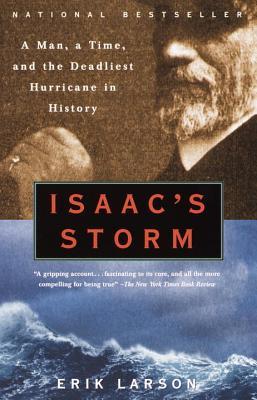
-Erik Larson, Isaac's Storm
I have to start by saying that I absolutely adore Erik Larson. He writes non-fiction that is gripping, page-turning delight. His book The Devil in the White City is one of my all-time favorites, and it is he (along with Jon Krakauer) who taught me to love non-fiction.
Larson's books tend to follow a pattern; he chooses an interesting, but forgotten event/era and brings it to life. He does so by focusing on the intimate details of a few lives (who become the main characters) and weaving those details in and among "big picture" descriptions of the event/era.
In Isaac's Storm the event is a devastating hurricane which nearly wiped the city of Galveston, TX off the map in 1900. Even now, 117 years later, it remains the deadliest natural disaster to have occurred on American soil.

Larson's sweeping descriptions of the storm and its aftermath are haunting. But it is in the details that Isaac's Storm doesn't quite land. Larson chooses to focus on meteorologist Isaac Cline, his brother Jacob, and a few fatuous men from the fledgling U.S. National Weather Service. He makes their stories as interesting as he possibly can, constructing the drama from old letters and telegraphs, but the story just didn't catch me.

I think part of the problem is that Isaac Cline, as a person, seems kind of cold and reserved, and so as the sympathetic center of the book, he just didn't quite work.
Still, the magical way that Erik Larson makes history come alive is always such a treat, and I fully enjoyed looking for further information and old pictures of the Galveston Hurricane. Any book that fires up my imagination in that way deserves at least 4 stars.
Friday, July 7, 2017
Book Review: Famous Modern Ghost Stories edited by Dorothy Scarborough

Famous Modern Ghost Stories, is kind of a laugh as a title. Having been published in 1921, it's hardly modern, and I hadn't heard of any of the stories in the collection, though I was familiar with some of the authors, so I would hardly say they are famous.
Apparently there's a longer version of this collection with a few stories that didn't make it into the version I read; there's a Poe story called "Ligeia" that I was missing, and another called "The Beast With Five Fingers" - I don't know why the version I read didn't include these stories.
I used to love creepy collections like this when I was younger. I checked them out from our local library and read some of them over and over again. One of them in particular contained a story called "The Toy Killer", about a mother that would destroy her son's toys, which always gave me the creeps (I think this story is the genesis of my obsession with stories about Munchausen's syndrome by proxy). I can't find the name or author of that collection, but I remember how much I loved reading horror stories, and how scared I used to be to go to the bathroom at night after reading them.
This particular collection was a little thin on real chills; there was a sweet little story about dogs waiting for their owners at the gates of heaven ("At the Gate" by Myla Jo Closser), another kind of sweet one about a ghost letting go of her former husband, and giving her blessing to his marrying her sister ("The Shell of Sense" by Olivia Howard Dunbar), and a cute story where a man puts to rest the ghost of young lovers ("The Haunted Orchard" by Richard Le Gallienne).
My hopes were high when I saw that Guy de Maupassant, author of the dark, ironic story "The Necklace", had a story in the collection. However, his story, "A Ghost", is one of the dumbest ghost stories I have ever read. Basically, the main character sees a ghost (so I guess it's aptly named) and then combs her hair. I feel like I missed something; perhaps it was written in French originally and something was lost in translation, because it seemed aimless to me.
"Lazarus" by Leonid Adreyev, is a creepy, atmospheric, zombie story that kind of touches on the same theme as Stephen King's Pet Sematary, namely, that sometimes death is more merciful than life. If you're familiar with the Bible, you will recognize Lazarus as the man Jesus raised from the dead in the book of John. This story is a meditation on what might have happened afterward. I personally thought it was a bit overlong, and it wasn't my cup of tea, but it did create a tense mood and atmosphere throughout.
The best of the collection is Algernon Blackwood's "The Willows." Although it too, suffers from being overly long (I actually skimmed the first 15-20 pages and basically missed NOTHING)- I started reading in earnest when the two main characters land on an island full of creepy willow trees and weird stuff starts to happen. If you're the type of reader who wants to know "what actually happened", (i.e., if you're the type of person who hates shows like Lost or The X-Files for not tying up all loose ends and answering all questions) then this is not the story for you. The willows are merely described as a place where the fabric between dimensions is thin and something malevolent is trying to get through from the other side.
It's a great example of a bottleneck story; the main characters are stuck on an island with a rising tide and are continually plagued by problems- losing their steering paddle, finding a hole in their canoe, etc., that keep them from leaving. This story is the longest of the collection and at 139 pages (at least in the digital version) it is really more of a novelette than a short story.
Overall, I probably wouldn't recommend this book to students who aren't experienced, high level readers. You need to be the type of reader who can expertly skim in order to get to the best parts, otherwise you will probably be bored as the pacing is certainly not ideal for modern readers.
Subscribe to:
Posts (Atom)